Trillion Dollar Babies: What today's giants actually looked like at age five.
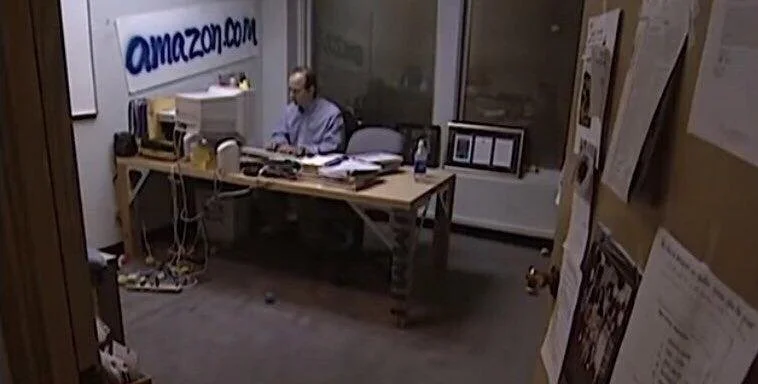
Jeff Bezos at his desk made from a home depot door
What did the biggest companies in the world look like in their early days?
I’m investing in founders building the megacap companies of the 2050s, so we need to understand what we’re looking for. I did some digging into Apple, Microsoft, Nvidia, Google, Amazon, Facebook, Tesla, SpaceX.
They all had rocky starts.
The Apple I was a bare circuit board with no case and no keyboard. Almost 99% of Nvidia's first chips came back as returns. SpaceX's first three rockets blew up. Microsoft's first-year revenue was $16,005.
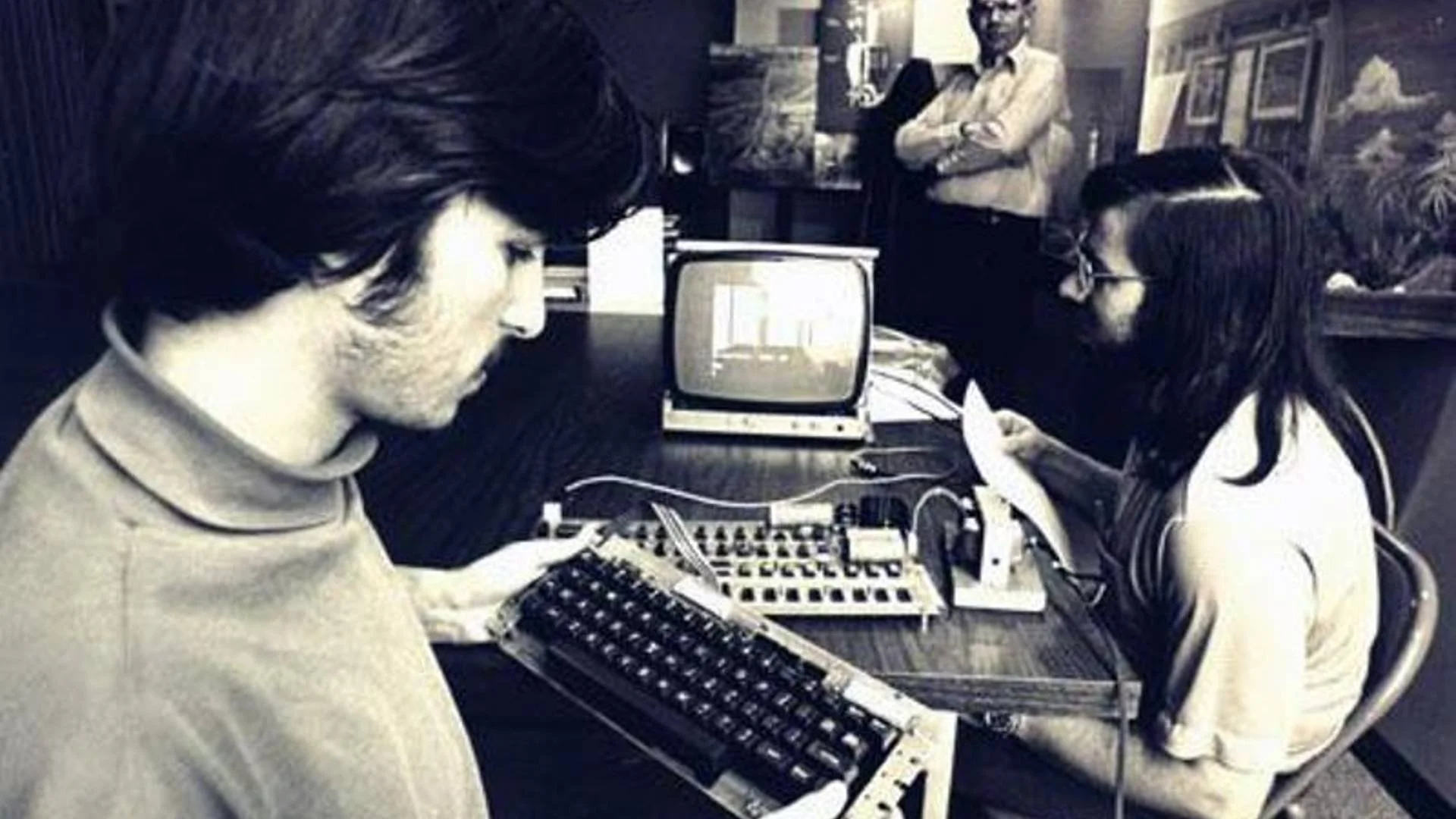
Steve Jobs and Wozniak
Every founder held a deep technical conviction the world thought was wrong, and structured the company on it being inevitable.
The convictions sound obvious now, but they were laughed at then.
Wozniak believed computers belonged in every home. HP rejected his design five times.
Gates and Allen believed software would be worth more than hardware, back when software was given away for free.
Bezos quit a hedge fund when he saw internet usage growing 2,300% a year, even though it was only 1994 and the internet was still considered a fad for geeks.
Jensen Huang bet on building 3D graphics chips in 1993, when gaming was a niche and Intel owned the world — a bet that built the foundation of the AI revolution.
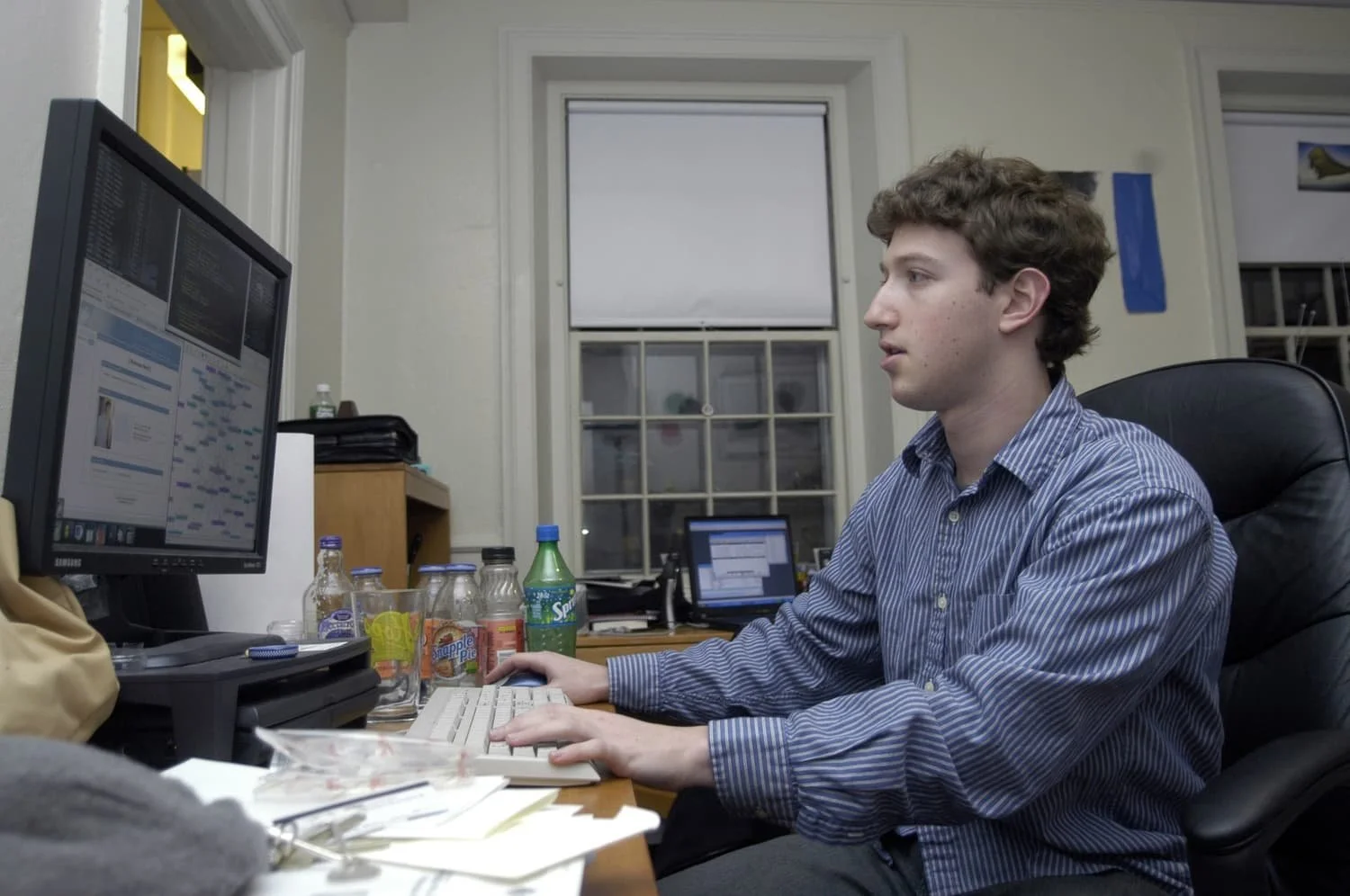
Mark Zuckerberg at Harvard in 2004
Zuckerberg bet on building a network of real names when the whole internet hid behind screen names.
Musk realized it was possible to build rockets that were reusable.
Musk committed to building an electric car company after seeing progress in Lithium-ion batteries for laptops and having conviction that electric cars were a fundamentally better product than gas-powered internal combustion engines.
They picked up faint signals about the distant future. They understood the physics, the math, and human nature. Then they worked to manifest their vision and update everyone else’s belief to see the possibility they did.
High conviction from early days is how founders create The Strong Form of the technology.
They make decision after decision based upon a belief that will only make sense years in the future. Decisions that preserved the potential for massive scale because they had a deep conviction in a future where their vision became common knowledge.
Woz designed the Apple II with expansion slots for cards nobody had invented yet, so when VisiCalc arrived, the machine was ready.
Jobs went with the full-screen touchscreen when the whole world believed in physical keyboards.
Bezos picked books as his first product, then built logistics and data systems for everything.
Huang spent years building CUDA for customers who didn't exist yet, so when AI arrived in 2012, his platform was the only one who could serve them.
Gates had to regain this position the hard way: his first deal gave MITS exclusive rights to BASIC, and he had to fight through arbitration in 1977 to win back the freedom to sell to everyone. He never made that mistake again. When IBM came for an operating system in 1980, Gates licensed MS-DOS non-exclusively — keeping the right to sell the same software to every computer maker on earth.
So what do trillion-dollar babies look like? Small and strange.
Individuals or small teams with extremely high conviction.
So terrified of being late that you’re terrifyingly early.
One or more potential technological feats that approaches magic.
A Zig when the rest of the world is Zagging.
Off the map of mainstream tech and venture capital.
The product would be obvious with one or two HUGE “IFs” (execution, environmental, or both) that the founder feels are inevitable and can explain why.
If you're holding a deep belief the market hasn't caught up to yet, and you're structuring your work around it anyway, you look exactly like these companies did in their early years.
If you are one of these companies or know one, please reach out to us.
We like to fund obsessive geniuses building utopian technology.
We are seeking singular visions. Founders who are working on things no one else is working on.
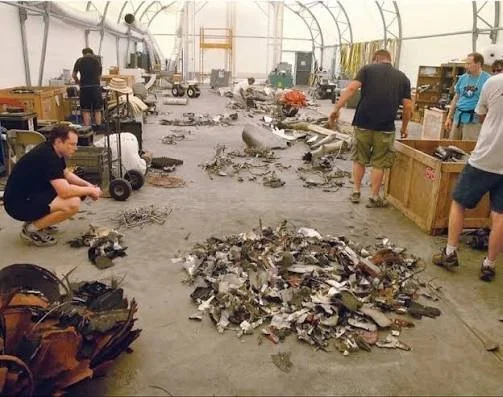
Elon staring at debris from Falcon 1
Some of the reasons Tesla, SpaceX, and NVIDIA find themselves dominating huge markets is no one else believed those markets existed. They spent 10+ years building a capability that would create the market.
Who are those founders building our next trillion-dollar babies today?
They’re each worthy of an essay or a whole damn book. Today, I’ll just share a sentence for each. [Disclosure, we’re investors in many of these founders.]
Casey Handmer (Terraform Industries) - Has conviction that the cost of solar energy is dropping fast enough that the potential exists to build a machine that can profitably produce synthetic natural gas from sunlight, water, and air… IF it can be designed and manufactured cheaply enough.
Ethan Loosbrock (Ouros Energy) - Has conviction that a new chemical manufacturing process can produce batteries (for cars, drones, robots, phones, laptops) with 10x the energy per mass.
Josie Zayner (Embryo Corporation) - Has conviction that CRISPR gene editing can be used at a much larger scale to produce new and valuable organisms.
Mike Grace (Longshot) - Has conviction that getting millions of tons of mass from Earth into orbit will require something with lower cost than rockets can possibly be, so he's building a new launch system with most of the mass on the ground.
Augustus Doricko (Rainmaker) - Has conviction that the technology exists to influence the weather and deliver precipitation where it’s most beneficial for us and our environment.
Ben Nowack (Reflect Orbital) - Has conviction that using large solar reflectors in orbit to redirect sunlight will produce even more efficient solar energy.
Carlos Araque (Quaise Energy) - Has conviction that a new drilling technology could enable deep geothermal energy generation, a huge cost and efficiency improvement over current geothermal.
Jim Coutre (Airship) - Has conviction that rigid airships (blimps, but hard) are a cheaper, faster, and lower carbon-emission system for air freight than huge planes burning jet fuel.
Mike Chieco & Mike Filler (Flying Wire) - Have conviction that compute chips and sensors can be applied and integrated into any physical material, 10,000x-ing the amount of data that can be collected and used.
Ahmed Shubber (Lumina) - Has conviction that the future of construction equipment (like bulldozers, diggers, etc) is electric and autonomous.
Celeste Holz-Schietinger (Green Abundance) - Has conviction that plants can be engineered to produce novel materials that are unavailable through current production methods.
Jacob Portukalian (Cascade Space) - Has conviction that a private communication network for crafts in deep-space will be key infrastructure for enabling missions outside of earth orbit.
Matt Gialich (Astroforge) - Has the conviction that we can profitably mine asteroids for platinum-group metals, given the trend in launch costs and cadence.
Ana Montero (Occam) - Has conviction that we can understand the biology and behavior of our brains (willpower, stress, decision-making) 10x better with new wearables and algorithms.
Zach Dwiel & Daniel Weddle (Terran Robotics) - Have conviction that better, more efficient housing can be built for a fraction of the cost with onsite materials (abobe) and cheap robots (cable gantry).
These founders are the engineers and pioneers of our generation. Give them a follow and support them however you can to make the future prosperous.
If you’d like to invest in companies like this, accredited investors can apply to invest alongside me today.