Why Winners Keep Winning (Preferential Attachment)
Whoever is ahead tends to pull further ahead, because being ahead is an advantage.
The critical, practical thing to drill into your brain is this: winners get disproportionate rewards. Then they’re more likely to win again.
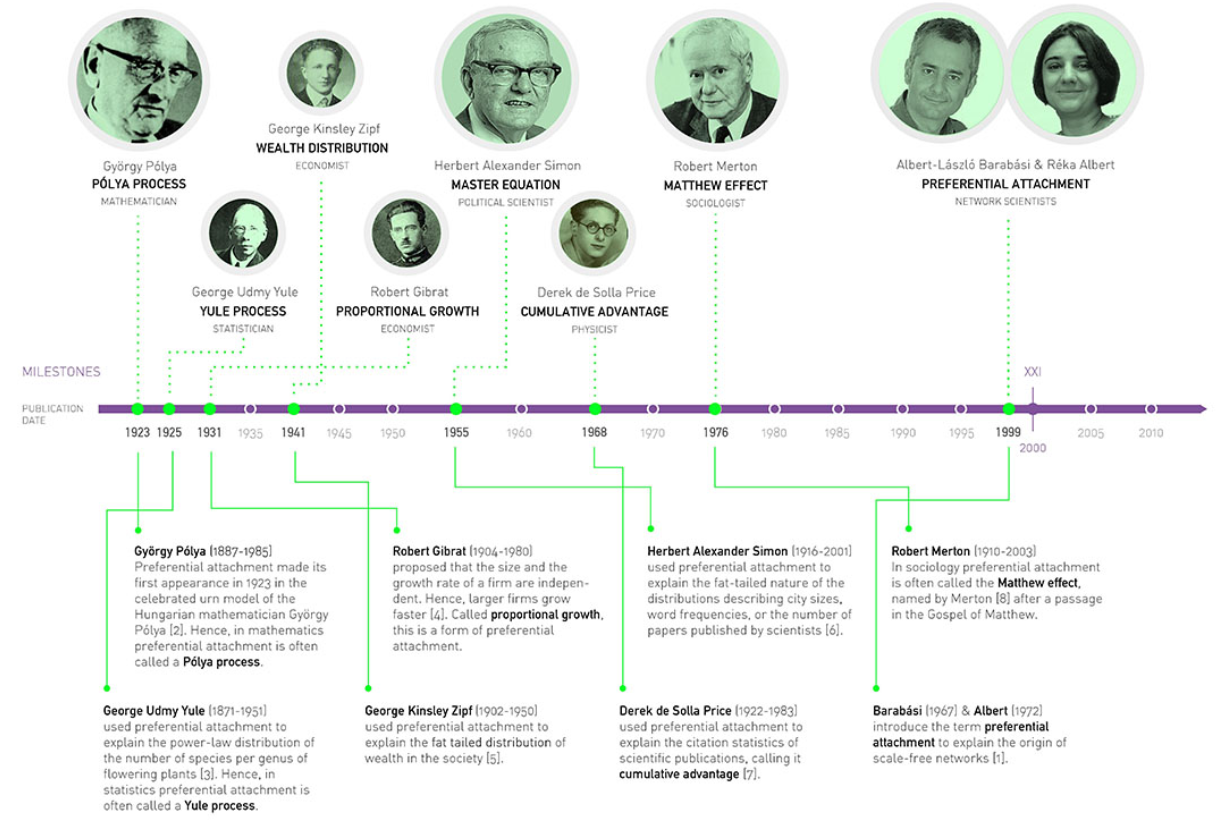
Network Scientists have a difficult-to-remember name for this: “Preferential Attachment.” Preferential Attachment was coined by Barabási and Albert in 1999. They wanted to explain the structure of the internet and power grids: A new node coming online will choose to connect to the most connected node.
But it generalizes, and this mechanism creates unbelievable, outlier Power Law outcomes.
You can picture this working very simply:
A new person shows up, trying to decide where to go.
They choose what seems best – often relying on signals from a crowd, a ranking, number of reviews, etc.
The previous leader just got more proof of their quality, so when the next person shows up, the same decision is even more obvious.
It’s rational decision-making, iterated many times, which reinforces the leader’s lead.
The basic idea shows up everywhere. It has been discovered and rediscovered in dozens of different academic fields:
Sociology — Known as the Matthew effect, named after a Bible verse about the rich getting richer. Merton in 1968 described how already-famous scientists get disproportionate credit for discoveries. arxiv
Statistics — The Yule process. Originally proposed in 1925, the study of how a genus will accumulate more species over evolutionary time. arxiv
Information Science — Called cumulative advantage. From Price in 1965 and 1976, who used it to explain why some research papers rack up citations while most are ignored. arxiv
Economics — Several overlapping versions. There's Gibrat's law (the "rule of proportionate growth," 1931), the idea that a firm's growth rate is independent of its size. The same growth rate (say 10%) will yield much larger absolute gains for larger companies. Also broader work on wealth concentration and "winner-take-all" markets where small early leads compound into dominance via Network Effects. arxiv
Biology/evolution — Shows up in how species accumulate population, protein networks accumulate connections, and how barnacles colonize a surface that's already got barnacles.
Linguistics — Explains word-frequency distributions (Zipf's law): common words get reused more because they're common.
Computer science/information retrieval — The principle behind Google’s PageRank algorithm: pages linked to by many others rank higher, get seen more, and earn still more links. Also drives recommendation systems and "trending" algorithms.
Demography / urban studies — Explains city-size distributions: big cities attract jobs → which attract people → which attract more jobs, producing a handful of megacities and a long tail of tiny towns.
A few more that are less academic and more everyday:
Hit songs on the radio. Before streaming, a song that got a little airplay got requested more, which got it more airplay, which got it requested more. DJs played what was popular, which made it more popular. A modest early nudge could snowball into a hit while an equally good song nobody happened to play first just... vanished.
The busy restaurant. You're walking down a street picking somewhere to eat. One place is packed, one is empty. You pick the packed one because "packed" seems like a signal. Your choice makes it one diner more packed for the next person deciding.
Follower counts. People find people more attractive when other people already seem to. A social account with lots of followers gets shown to more people, who follow it, which gets it shown to more people. The crowd is doing the persuading. (Same is true with dating, though… that’s a bit more complicated.)
You also see it in truisms of business culture. It’s like the famous speech from Glengarry Glen Ross:
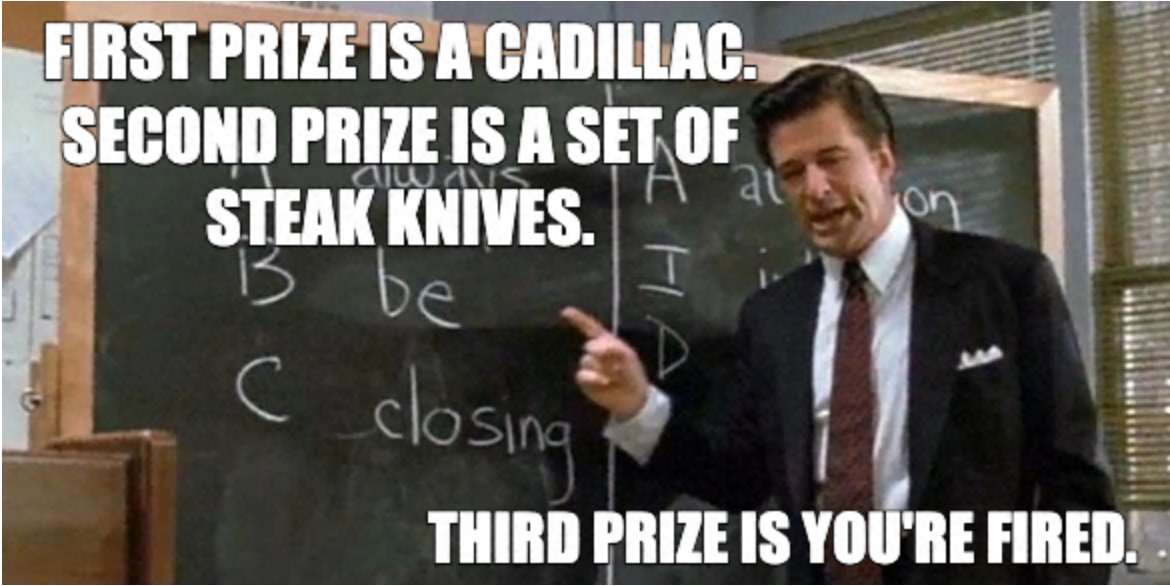
Young, handsome, Alec Baldwin’s iconic line applies to everything.
Marc Andreessen describes the startup game as the challenge of accruing new resources and how much momentum matters. (An excellent bit on Cheeky Pint about this dynamic!.)
A startup's success compounds by having (or appearing to have) a lead, decision by decision. A strong founder will have a better demo and early traction, which raises a strong first round of capital, which attracts better engineers, who build a better product, which attracts the most customers, which makes the next round easier to raise, which buys more talent and more customers, which makes the round after that easier still.
Winners are the snowball that grabs more snow with every turn. Their lead widens with each turn. Preferential attachment is the mechanism that drives outlier outcomes.
This is part of why investors’ reputations matter so much. We work hard with startups early on to build strong cohorts of co-investors, refine their story, and own the mindshare for their category. When you get a strong signal early, the momentum compounds fast, and the speed becomes its own signal. If you want to raise from us or invest with us, check out Rolling Fun.
It’s also the unspoken truth behind “No one ever got fired for buying IBM.” (Referring to corporate buyers feeling their jobs were safe by picking the current market-leading vendor, even if smaller startups had more compelling products.)
It’s why “fake it until you make it” is such oft-repeated advice. You want to send the signal of leading, even and especially when it’s not clear who is leading.
This same dynamic applies in sports. There are huge returns to being the best player on a team. And, for those on the lower end, there is a cutoff point below which it becomes extremely difficult to keep progressing. Third prize is you’re fired.
The cleanest data-backed version of this is birth dates of Canadian Youth Hockey. The age cutoff for youth leagues falls on January 1, so a boy born in early January and a boy born the following December are in the same age group despite being almost a full year apart. At eight or nine years old, the maturity difference is massive. The January kid is bigger, faster, and better coordinated, so coaches read him as more talented and stream him onto the elite team.
There he gets more ice time, sharper coaching, and tougher opponents, while the December kid stays on the recreational squad with less of all three. A tiny, arbitrary head start snowballs into a real skill gap that determines destiny.
This goes all the way up to the pro roster. Top athletes get max contracts. Then they go on posters and sell more merch. Then, they get more endorsement deals, earn more money, and become more famous. That fame drives higher ticket sales, higher contract values, higher endorsement deals.
The effect of the power law is actually so extreme that salary caps disproportionately harm star athletes. “LeBron James is underpaid” is a fascinating look at this topic from the Planet Money economists.
Same in social media…
YouTube clippers can get views by using the biggest podcasters’ faces. So they do, which makes top podcasters even more recognized.
The biggest podcasters can get the biggest guests, because they have the largest audiences. Those unique guests drive more listeners, and the cycle continues.
So… what do you do?
If you are building anything: a newsletter, a business, a band, or a YouTube channel, this principle should change how you think and prioritize. A few tips:
Early momentum is worth more than it seems. Your first hundred real fans are crucial, because they are the start of the snowball, the signal that tells the next person other people are already here. (Perhaps this is why Paul Graham’s YC advice focuses on “doing things that don’t scale” and manually getting early customers by any means necessary.)
An early lead can beat quality. The best product doesn't always win; the one that got traction first often does. If you're choosing between polishing your thing to perfection for another year versus getting a rougher version out into a space nobody's claimed yet, this is why you should get out there. You want to be early enough to become the thing people gather around.
Do whatever it takes to be #1. The difference in value between being first and second could be 100x. Scratch, claw, and scrap to get to #1. First prize is worth much, much, much more than second prize. Third prize is you're fired.
Make your success visible. Because popularity is a signal, hiding your traction is silly. Attention begets attention, so share proof of progress as you go.
Feed what leads. When something starts to catch on, the instinct is often to derisk. But the piece that's working is already snowballing. Pushing that drives more returns than diversifying. (I've definitely made this mistake!)
We’ll close with a few quotes that align and reinforce this idea:
“Being the winner means being in the 99.99-percentile. A winner at the top takes nearly everything, and only a pittance goes to all the others — so being 99.99-percentile is worth an order of magnitude or two more than being just 98-percentile. If it’s 1am and you’ve already got something that is very good, this is why it’s worth spending the next couple of hours to make it amazing.”
“Don’t divide your attention: focusing on one thing yields increasing returns for each unit of effort.
At a micro level, an extra hour of focus on the current project has a much higher return than an hour on something new, or worse, 5 minutes each on 12 new things. Before you ever do something new, you should understand the opportunity cost vs. existing things. Don’t rationalize that something you want to do is complementary when it’s not!
At a macro level, understanding that applied effort has a convex output curve is a very useful discipline when considering new market areas. This convexity means that the opportunity cost of transferring resources from existing projects to new ones is high. Unless the new area is incredibly valuable, anything we can do to extend an existing convex curve is worth so much more.”
“Being at the extreme in your art is very important in the age of leverage.”
- Naval

Want to invest in early-stage startups together?
When new technologies meet the market, the world changes for the better. That's why we invest in obsessive geniuses building utopian technologies.
We write small checks to 15-20 very different startups each year. Previous investments include Aalo Atomics, Ouros Energy, Stell Engineering, Airship, Terraform Industries, Longshot, Dirac, Occam (stealth), Atomic Industries. and more.
Our Website has background on the fund, our past deals, and more.
*Startup investing is risky, illiquid, and not for the faint-of-heart. Be warned.
Accredited Investors: reply to this post, and we'll get you into our new investments starting this quarter.