The Dysmorphia of The Present
TLDR: We are pessimistic and terrified of change in the present, but glorify changes that happened in the past. Read on to see through the fear and falsehoods born of our widespread anxiety about change and how to be right when others are wrong.
A mere 130 years ago, newspapers around the world screamed warnings to women about “bicycle face.”
Riding a bicycle, they said, would strain your features into a permanent grimace. Bulging eyes and a clenched jaw. Doctors claimed this. Medical journals covered it.
As described by Missed History, it was “cultural anxiety dressed in medical clothing.” (And not a small dose of chauvinism.)
A few decades before that, doctors warned that trains moving 30 miles an hour would suffocate passengers, or shake their organs loose inside their bodies.
They had experts, headlines, and consensus. And they were completely, hilariously wrong.
You're laughing too?
Good.
Keep that in mind.
Because those people were as certain and fearful about their absurd anxieties as you are right now.
We’re all great at spotting this in the past. We are terrible at spotting it in the present.
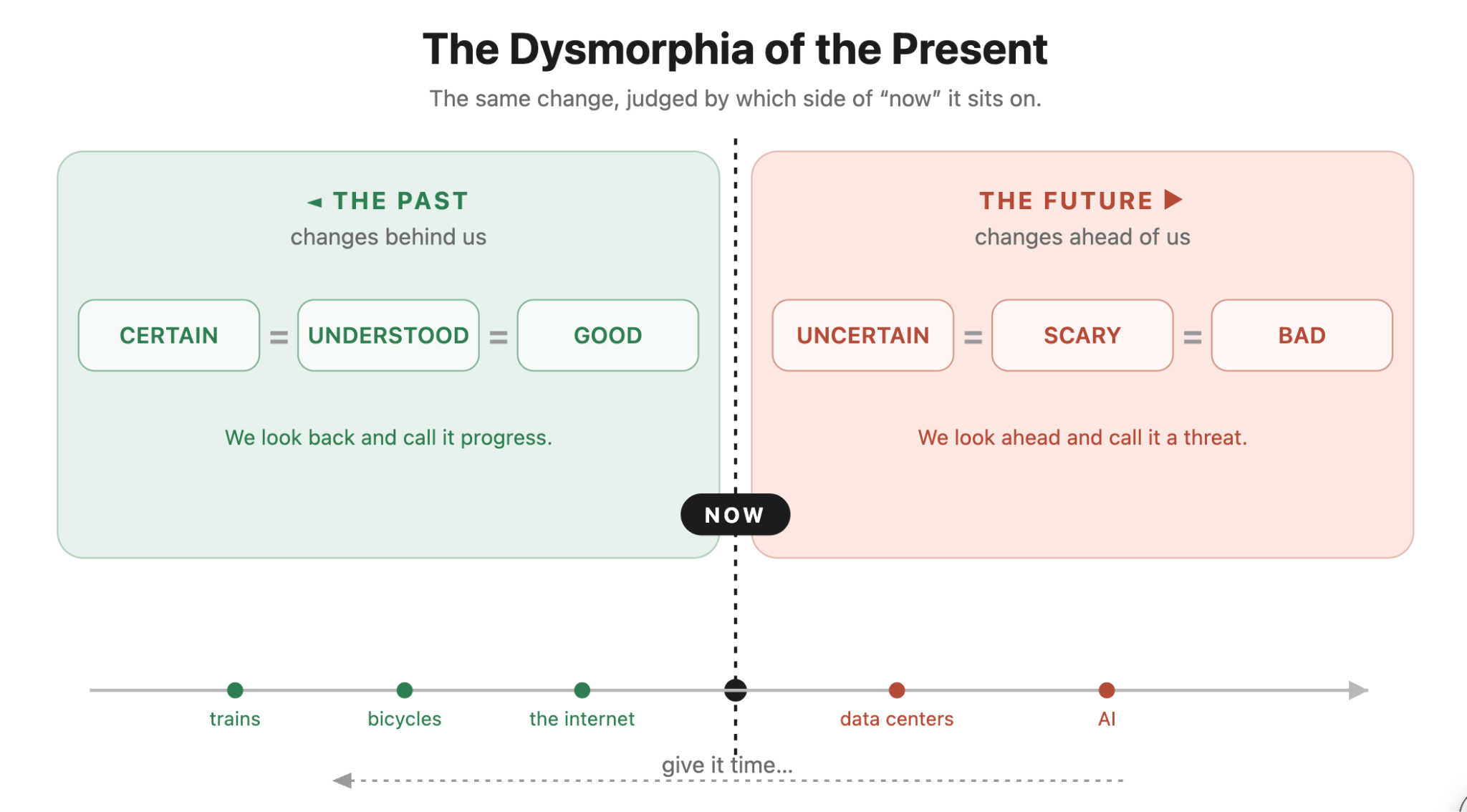
I call this The Dysmorphia of The Present.
Body dysmorphia is when someone looks in the mirror and sees a distorted version of themselves. Anorexia nervosa is most common. They're sure they are too fat, even though they are wasting away. Everyone around them can see the obvious truth, but they can't.
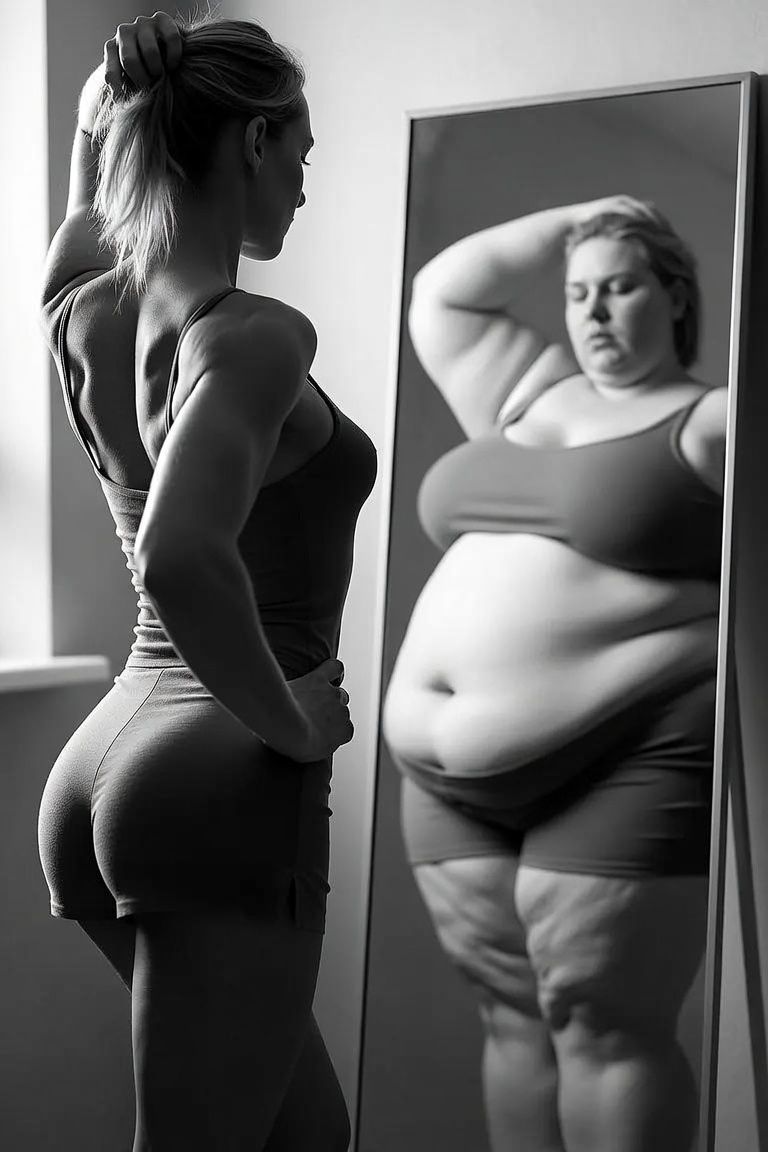
(This isn’t an example of Anorexia, where the patient is often truly skeletal. It’s an illustration of how good the present is relative to our perception.)
The ability to observe is broken. The feedback loop with reality is distorted.
This is the relationship we have with the boogeymen of the present.
We see something uglier and scarier than it really is. Like the person at the mirror, we can't tell we're doing it. The future will see our foibles clearly, but it’s very hard to get perspective on the present moment when we're inside it.
It’s important to realize the distortion of our observations always leans toward doom.
Bad news is heard louder than good news. Threats grab our attention. We’re wired this way. It’s a trait selected for by evolution. We’re paranoid by nature.
We’re also bad at evaluating the value of change. We perceive change as threatening, almost universally. Although young people tend to be better at it than older people.
Douglas Adams has a joke illustrating this:
I've come up with a set of rules that describe our reactions to technologies:
1. Anything in the world when you’re born is normal and ordinary and is just a natural part of the way the world works.
2. Anything that's invented between when you’re fifteen and thirty-five is new and exciting and revolutionary and you can probably get a career in it.
3. Anything invented after you're thirty-five is against the natural order of things.
Learn to Recognize The Pattern
The past ‘presents’ get edited down to a clear story as history. When you look back, history is trimmed down to just the things that mattered. The present shows up as raw noise, so it feels like overwhelming chaos.
Once you see the shape of change-driven paranoia, you see it over and over again in history:
Novels are rotting young women's brains.
Newspapers are killing polite conversation.
Telephones are killing the art of the visit.
Comic books are breeding criminals.
Television is melting kids’ brains.
Video games are causing violence.
Anything new is decried and vilified with certainty by professionals and experts in the press.
The dysmorphia doesn't just warp our view of technology.
It warps how we judge people in the present.
I notice this in how people talk about Elon Musk (since the book launch, I have had lots of conversations about Elon Musk).
In the past, he's a genius. PayPal, self-driving cars, and rockets that land themselves.
But in the present, when we evaluate his claims about what comes next… robotaxis, orbital data centers, humanoid robots, the majority of people think he’s wrong and believe their pessimism is well-informed.
There’s immediate amnesia, too, so most people never realize they made this mistake.
What do you do about it?
Ask yourself: What are you certain about right now that will look silly in ten years?
The answers are not obvious. If we could easily see it, it wouldn't be dysmorphia.
But you can fight the bias and see through the distortion.
Try these:
What are your friends or relatives certain about right now that you think will look silly in ten years?
What might you have written or recorded 10 years ago that you’d be embarrassed to see today?
What are you most afraid that you are wrong about?
What beliefs have made their way into your brain from headlines, magazine covers, or pundits unexamined?
Where have you felt yourself turning away from evidence or conversation that might have disproven something you believe?
When have you reacted emotionally when probed on a belief?
Does your belief have an objective correct answer, but you didn’t research further?
Here’s another tactic: Ask “boring” questions that frame the fear.
Compared to what? (Put this data into context for me.)
Is a data center's water use big or small next to golf courses?
How much land do data centers currently use compared to farmland?
What are the most recent unemployment numbers?
Are they higher or lower than the average of the past 10 years?
Do cities with rent control have higher or lower average rents?
Do self-driving cars have fewer fatal accidents than human drivers?
With current AI tools, it takes only TEN SECONDS to find actual answers to these questions.
But most people won’t do it.
It can be uncomfortable to be the person who asks questions when everyone else is sitting at the dinner table lamenting the same misleading article… but it can be refreshing to have an optimistic alternative to the doom and gloom.
What are the forces driving incorrectness?
Pundits Do The Opposite Of The Job
You might think the people we pay to interpret the present professionally would be good at it. They're often the worst, because the job rewards confidence and volume, not accuracy.
The louder and more certain they sound, the worse the take probably is. The appearance of certainty is what makes the message spread. And without critical thought, we are persuaded by the appearance of certainty.
Beware the “Non-Practitioner Predictor.” The incentives and feedback loops are not iterating toward truth, they are focused on gathering attention. Read Skin In The Game, if you haven’t yet.
This is a system that produces reliably wrong predictions. For every successful company, you can find a cover story or headline claiming they were doomed to failure.
Mistakes + Motivated Reasoning
We all want to be good people and have people like us.
This desire, combined with well-intentioned mistakes, can spiral into debacles that are somehow both comedy and tragedy.
Have you seen headlines claiming “Data centers are using all our water”?
Much of that panic traces back to one number in one book.
Karen Hao's Empire of AI, published in 2025, described a data center in Chile using a staggering amount of water. The figure was off by about 1,000x. She wrote that it used a thousand times a nearby city's water. It actually used about a fifth of what that city used.
She corrected it, but the wrong number kept traveling anyway because it confirmed something people already wanted to believe. (Motivated Reasoning should be another essay).
Thousands of smart and well-intentioned people passed it along without checking it. Please don't be a link in that chain. Never repeat a number you haven't at least quickly googled.
As another example… remember that whole plastic straw thing!?
Around 2018, the US decided straws were enemy #1. The media pushed it out, people posted and shamed each other, and policy changed. Cities banned them. Starbucks ditched them. Companies redesigned their lids.
The number driving all of it: “Americans use 500 million straws a day.”
That number came from Milo Cress. In 2011, Milo called a few straw manufacturers, asked them to guess, and did some math. Milo was nine years old.
His estimate got picked up by CNN, New York Times, and the National Park Service, none of whom seem to have checked it. (Actual market research later put the real figure somewhere between 170 and 390 million.)
No shade on Milo here, who was doing his best (and did get an estimate within 50%!) But this feels like the setup of a Dilbert cartoon.
The more salient point is that plastic straws are 0.025% of ocean plastic.
If you cared about solving the actual problem (plastic in the ocean), you’d ask “what is the biggest single contributor?”
The actual heavyweight is fishing gear: abandoned nets, lines, and traps make up nearly half of the Great Pacific Garbage Patch by weight, and roughly a fifth of ocean plastic worldwide.[1]
It’s roughly a thousand times more important than plastic straws.
But have you ever seen a headline about it? Had a conversation about it? Seen a policy written about it?
Most of the rest of the plastic washes into the ocean through rivers from bad waste management systems, largely in a handful of heavily populated countries with limited infrastructure in Asia.[1]
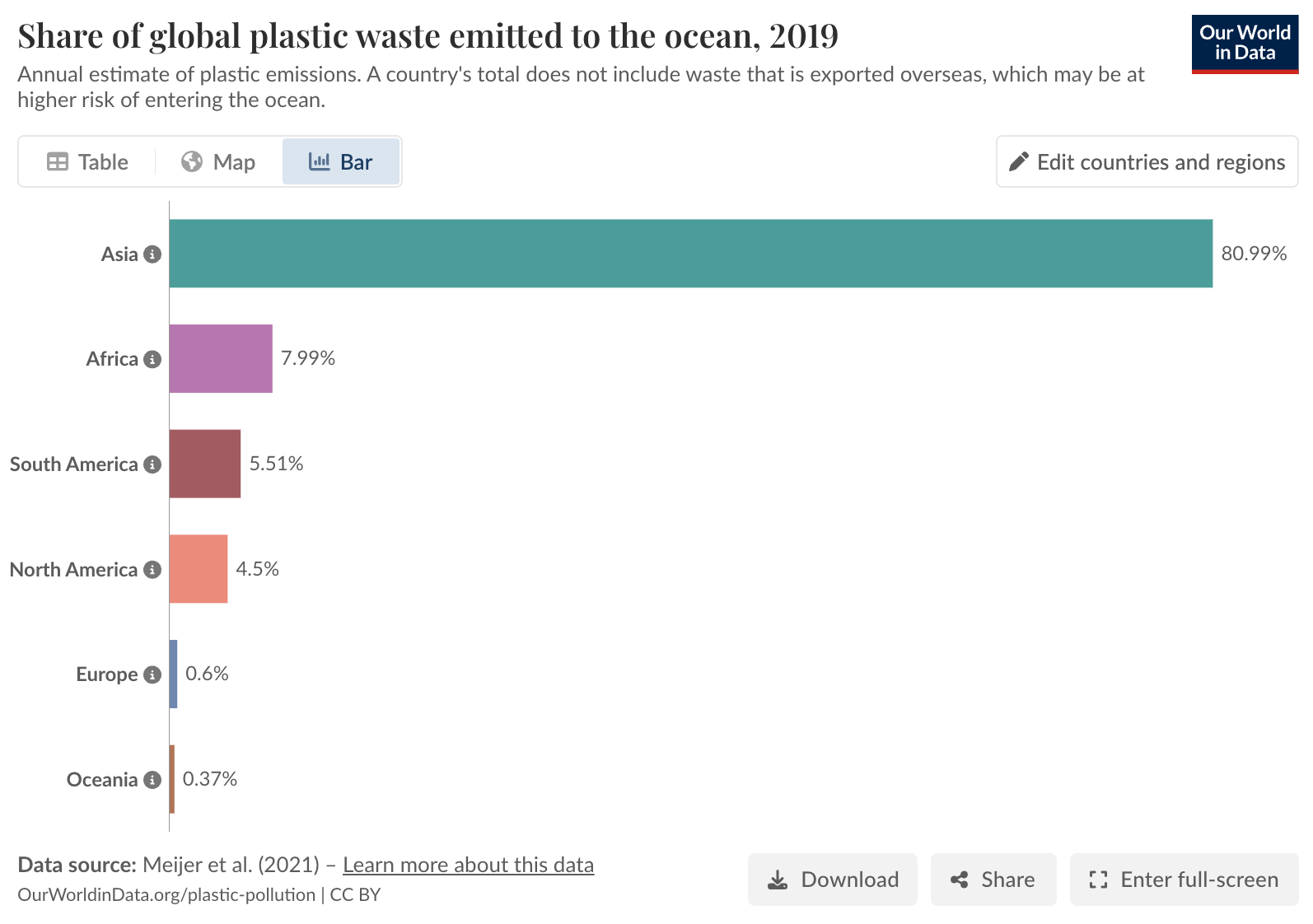
Of course it’s not fashionable to blame poor countries for pollution, so we don’t. And it IS fashionable to care about the environment, so people in the developed world hyperfixate on any visible contribution they can make to signal their status.
Straws are approximately irrelevant.
But they dominated the conversation for years.
It’s absolutely farcical.
Our ability to thrive as a species depends on our ability to gain and transmit correct knowledge.
We have room to improve this skill.
Selfish Agendas + Propaganda
Ask another question: Who benefits from me being scared of this?
For example: Lawyers make billions of dollars by suing car companies for injuries. They have been lobbying against Autonomous Vehicles for years, heedless of the injuries and deaths this creates, merely seeking to protect their gruesome cash cow.
Another example: China has invested massive money and effort into propaganda to make Americans believe data centers are bad, because this gives them an advantage in the AI race.[1, 2, 3]
But it doesn’t have to be a conspiracy… our human tendency to fear change is so robust and reliable that anyone seeking social and political influence can throw stones at any new change and gather a crowd of the fearful.
This is the practice of Scapegoating, and it’s well-studied by memetic experts like René Girard (the original) and Luke Burgis (who simplifies Girard for us).
Zoom Out, Remember our Win Streak
Here’s the simplest tactic of all: Zoom out.
The present is becoming the past. We just need to try to see it through the future’s eyes.
Many things seem obvious if you simply look at them from a longer time horizon. Take into account how many problems we’ve solved before. How much time we have to solve the problem. Whether the problem is actually a problem or just something that makes us a little itchy. (Remember the “cultural anxiety” label from the opening?)
In calibrating my fear response to headlines or the fashionable panics of the present moment, I often think of “Scott Adams Law of Slow-Moving Disasters”
“When we see a disaster coming–as we do with climate science–we have an unbroken track record of avoiding doom.
If you ask me how scared I am of climate change ruining the planet, I have to say it is near the bottom of my worries.”
From Scott Adams’ talk at Hoover Institution
I think of how many problems we’ve solved in the past:
Smallpox killed 300 m people in the previous century. Completely eradicated.
Guinea Worm. (it’s so gross, google it. But we fixed it.)
Polio paralyzed 350,000 people a year as recently as 1988, mostly kids. Gone.
Hole in the Ozone layer was a global emergency in 1980s. The Montreal Protocol (1987) banned CFCs, and the layer is on track to fully recover between roughly 2040 and 2066.
Acid Rain - dominant environmental fear of the 1980s. A sulfur-dioxide cap-and-trade system (US Clean Air Act, 1990) quietly solved most of it.
Malaria is eliminated from the developed world, and progress is being made on the rest.
Y2K Bug was a real bug with real risk. Solved by a massive, unglamorous remediation effort by engineers. People now remember it as a fake panic because nothing broke.
The list goes on and on, and is a worthy essay (or book) on its own. But this is the shape of the cycle. Most people panic and post, and a few quietly solve problems.
I think of David Deutsch’s two maxims:
PROBLEMS ARE INEVITABLE.
PROBLEMS ARE SOLVABLE.
You will never be 100% correct. But you can:
Avoid being swept up in the current fear and mindless incorrectness.
Cultivate a respectful skepticism of the current mass paranoia.
Be less wrong than the crowd. That's a skill with huge returns.
Be one of the quiet heroes (often scientists and engineers) who solve problems.
(You can also subscribe to “Our World In Data” which is a fantastic resource for fact-finding.)
This is your life. Your beliefs steer your destiny.
Don’t underthink it.

Want to invest in early-stage startups together?
When new technologies meet the market, the world changes for the better. That's why we invest in obsessive geniuses building utopian technologies.
We write small checks to 15-20 very different startups each year. Previous investments include Aalo Atomics, Ouros Energy, Stell Engineering, Airship, Terraform Industries, Longshot, Dirac, Occam, Atomic Industries. and more.
Our Website has background on the fund, our past deals, and more.
*Startup investing is risky, illiquid, and not for the faint-of-heart. Be warned.
Accredited Investors: reply to this article, and we'll get you into our new investments starting this quarter.