Argentina Under Milei
Something fascinating is happening in Argentina.
Javier Milei may be the most libertarian head of state ever elected, anywhere.
He describes himself as an anarcho-capitalist.
He calls taxes theft and the state a criminal organization.
He has lambchop sideburns and looks like he belongs in The Beatles.
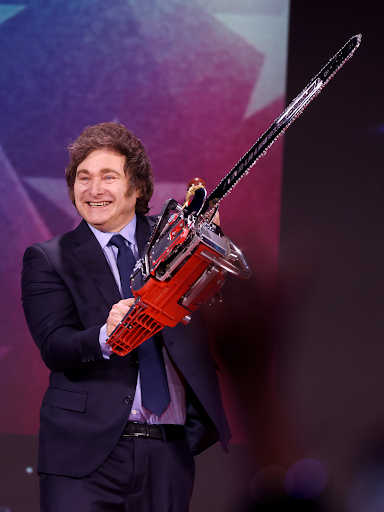
I’ve asked many people if they’re aware of President Milei or what’s happening in Argentina… so far I’m 0/15.
Argentina had been wrecked by a century of overspending and money-printing, with inflation at 211%.
His response was radical free-market shock therapy: slashing the government, balancing the budget, and freeing the currency.
Two years in, it's working.
Whatever your politics, it's one of the most important economic case studies of our time.
I’ve been loosely following, but I didn’t have enough context to really understand the history and the impact of his moves.
So, I had Claude do some research and writing for me, which produced the piece below. (Edited to make it more readable.)
I found it quite interesting and useful.
Enjoy!
Argentina Under Milei: A Nation Saved By Free Markets
The Most Libertarian President Ever Elected, a Century of Failed Government Intervention, and The Free-Market Experiment That Works
Introduction: The Chainsaw President
"There is no money. There is no alternative to austerity and shock measures."
With those blunt words in his December 2023 inaugural address, Javier Milei announced a radical new economic policy for Argentina. He may be the most genuinely libertarian head of state ever elected anywhere—a self-described anarcho-capitalist who calls taxes 'theft' and the state a 'criminal organization.’ He campaigned wielding a chainsaw to symbolize the cuts he promised to make to government spending.
He inherited an Argentina wrecked by a century of overspending and money-printing, with inflation running at 211%. His response was radical free-market shock therapy: slashing the size of the government, balancing the budget, and freeing the currency.
Two and a half years later, it's working: inflation crushed, growth returning, poverty now lower than when he started, foreign reserves at a seven-year high, and voters handing him a decisive midterm win. There have been real costs too: atemporary spike in poverty, protests, and rising unemployment.
Whatever your politics, it is one of the most important economic case studies of our time.
To understand what Milei has done, you first need to understand how Argentina got into this mess in the first place. This is a story that stretches back nearly a hundred years.
Part I: How Argentina Went from Riches to Ruin
The Golden Age (1880s–1930s)
Argentina was once one of the richest countries in the world. In 1913, it had a higher GDP per capita than France, Germany, or Italy. Buenos Aires was called 'the Paris of South America.' The country grew wealthy exporting beef and grain to Europe, and immigrants flooded in from Spain and Italy seeking opportunity. Argentina seemed destined to join the ranks of the world's great powers.
So what happened?
The Rise of Perón (1940s–1950s)
Juan Perón was an army colonel who rose to power in the 1940s, eventually becoming president in 1946. He is the most important figure in understanding modern Argentina because he is the source of most of its problems.
Peronism (also called 'Justicialism') is a political movement that's hard to classify on a traditional left-right spectrum. It combined strong labor protections and powerful unions; economic nationalism and the nationalization of foreign-owned industries; state-led industrialization through tariffs and subsidies; and charismatic, populist leadership. Perón and his wife Eva ('Evita') cultivated quasi-religious devotion among the working class.
Perón's economic model involved heavy government spending on social programs and wages, funded partly by taxing agricultural exports. This redistributed wealth from rural landowners to urban workers. This political formula got support from labor unions for generations, but it created structural problems.
Taxing agricultural exports discouraged farmers from producing more. State-owned industries became bloated and inefficient. The government consistently spent more than it collected.
Perón was overthrown by a military coup in 1955, but his ideas never died. Peronism became Argentina's dominant political identity, and the Peronist party has won most elections since democracy was restored in 1983.
The Cycle of Crisis (1970s–2001)
For decades, Argentina fell into a repeating pattern. First, the government would spend heavily on wages, subsidies, and social programs to win elections.
Then deficits would grow because spending exceeded tax revenue.
Rather than cut spending or raise taxes (both politically painful), the government would print money to cover the gap.
This caused inflation because too much money chased too few goods.
The currency would collapse as people lost faith in the peso and rushed to buy dollars.
Eventually a crisis would force a reset. Sometimes through military coups, sometimes through emergency economic plans. Then the cycle would begin again.
The pattern produced some spectacular disasters. From 1976 to 1983, a military dictatorship killed tens of thousands of suspected leftists in the 'Dirty War' while also mismanaging the economy. In 1989–1990, inflation reached nearly 5,000% per year. Prices changed multiple times per day, and people rushed to spend their paychecks immediately because the money would be worthless by week's end.
In 1991, President Carlos Menem tried something radical: he pegged the peso to the US dollar at a 1:1 ratio. This killed inflation almost overnight. But it created a new problem.
Argentina couldn't devalue its currency to stay competitive, and it couldn't print money to cover deficits. The government borrowed heavily instead.
By 2001, Argentina couldn't pay its debts. The government froze bank accounts, preventing people from withdrawing their savings.
Riots erupted.
The president fled the presidential palace by helicopter.
Argentina defaulted on $100 billion in debt. It was the largest sovereign default in history at that time. The peso lost 75% of its value almost overnight. Poverty soared to over 50%.
The Kirchner Years and the Return to Peronism (2003–2023)
After the 2001 collapse, Néstor Kirchner (2003–2007) and then his wife Cristina Fernández de Kirchner (2007–2015) led Argentina back again to classic Peronist economics.
They defaulted on debt and fought creditors in court for years.
They nationalized industries, including the oil company YPF.
They expanded subsidies for energy, transportation, and food to keep prices artificially low.
They imposed currency controls restricting people's ability to buy dollars, creating a thriving black market.
They implemented price controls on basic goods.
The philosophy was that the state should actively manage the economy to protect workers and the poor from market forces. Free markets and foreign investment were viewed with suspicion.
The result was predictable.
Inflation crept back up (though the government manipulated official statistics to hide it).
The gap between the official peso-dollar rate and the black market rate widened. Investment dried up. Argentina was largely shut out of international credit markets.
A brief center-right government under Mauricio Macri (2015–2019) attempted gradual reforms but was overwhelmed by a currency crisis and lost re-election to another Peronist government.
Under President Alberto Fernández, with Cristina Kirchner as vice president, money printing accelerated, especially during COVID-19.
By 2023, inflation hit 211%, the highest in the world. The peso was essentially worthless. The poverty rate exceeded 40%.
This is the context in which Javier Milei, a TV economist who had spent years railing against 'the political caste', won the presidency.
Part II: The Milei Experiment
The Philosophy
Milei is not a conventional politician. He describes himself as an anarcho-capitalist and cites economists like Murray Rothbard, Friedrich Hayek, and Milton Friedman as his intellectual heroes.
His views are radical even by free-market standards.
"The state is not the solution," Milei has said. "The state is the problem itself."
He goes further: "The state is a criminal organization that lives off a coercive source of income called taxes."
And: "Taxes are theft."
This isn't just rhetoric.
Milei genuinely believes virtually all government intervention in the economy is harmful.
At the World Economic Forum in Davos, he told the assembled global elite: 'Don't be intimidated by the political class or the parasites that live off the state.'
He called successful entrepreneurs 'heroes' and declared: 'Don't let anyone say ambition is immoral.'
His signature catchphrase, shouted at rallies and printed on merchandise, captures his worldview in four words: '¡Viva la libertad, carajo!' ('Long live freedom, damnit!')
Phase One: Shock Therapy (December 2023–June 2024)
Milei wasted no time.
Within his first month in office, the number of ministries (departments) was cut by more than half, from 18 to 9. More than 34,000 government employees were laid off. Subsidies for energy, transportation, and other services were eliminated or drastically reduced. Some utility bills increased by 1,500% as the true cost of services was passed on to consumers.
The peso was devalued by more than 50% against the dollar in a single stroke. Public works projects were frozen. Social programs were cut across the board.
The chainsaw was put to work. The immediate effect was brutal.
In the first half of 2024, the poverty rate spiked from 41.7% to 52.9%. Consumer spending collapsed.
Milei's response to the suffering was unapologetic. “You don't get out of poverty by magic.”
He said, “You get out of poverty with capitalism, savings and hard work.”
Finally, “There will be light at the end of the road.”
Phase Two: Monetary Stabilization (June 2024–April 2025)
Something remarkable began to happen.
By refusing to print money to cover government deficits, and by making the central bank genuinely independent from executive interference, Milei's team began to strangle inflation at its source.
Monthly inflation, which had hit 25.5% in December 2023, began a steady decline.
By February 2024, it was down to 13.2%. By February 2025, it had fallen to 2.2%.
By May 2025, monthly inflation reached a five-year low of just 1.5%, with wholesale prices actually declining, the best figure in 17 years.
For the full year of 2025, annual inflation came in at 31.5%, which is still high by global standards, but the lowest Argentina had seen since 2017, and a stunning drop from the 211% Milei inherited.
The government achieved its first primary budget surplus in 14 years, at 1.8% of GDP.
Phase Three: Currency Liberation (April 2025)
In April 2025, Milei implemented perhaps his most symbolically significant reform: Argentina lifted most of its long-standing currency controls.
The 'cepo cambiario' had restricted citizens' ability to purchase dollars or transfer money abroad for years, creating a black market and driving capital flight. For the first time in years, Argentines could freely buy and sell foreign currency.
The move was accompanied by a new IMF agreement providing $42 billion in financing, which showed confidence from international institutions that had once written off Argentina as hopeless.
Economic Results
The macroeconomic turnaround has been remarkable.
Argentina posted a record $18.9 billion trade surplus in 2024, reversing decades of chronic external imbalances.
The country became a net energy exporter for the first time in 14 years.
International investors began returning. Goldman Sachs projected 3.5% GDP growth for 2025; BBVA forecast 5.5%. Markets that had once written off Argentina were reconsidering.
One unexpected success came from the rental market. By repealing rent controls (which are intended to protect tenants but consistently backfire), the government actually improved housing availability: rental housing supply rose by 170%, while real rent prices (adjusted for inflation) fell by 40%. Landlords who had withdrawn properties under the old rules returned them to the market.
By mid-2025, the poverty rate had fallen to 31.6%, lower than when Milei took office.
The 2026 Verdict: Vindication, With Caveats
By the middle of 2026, the trends that looked promising in 2025 had hardened into something closer to a track record. Inflation continued its remarkable descent: monthly inflation fell to 1.9% in June 2026, a ten-month low.
It represented the fastest disinflation of any major economy in decades, from 211% to the low thirties in two and a half years.
Growth arrived as promised. After the economy contracted 1.7% in 2024 when the cuts landed, it rebounded to grow 4.4% in 2025, and the IMF projected roughly 3.5% growth for 2026, one of the fastest rates in Latin America.
The 'light at the end of the road' that Milei had promised is materializing.
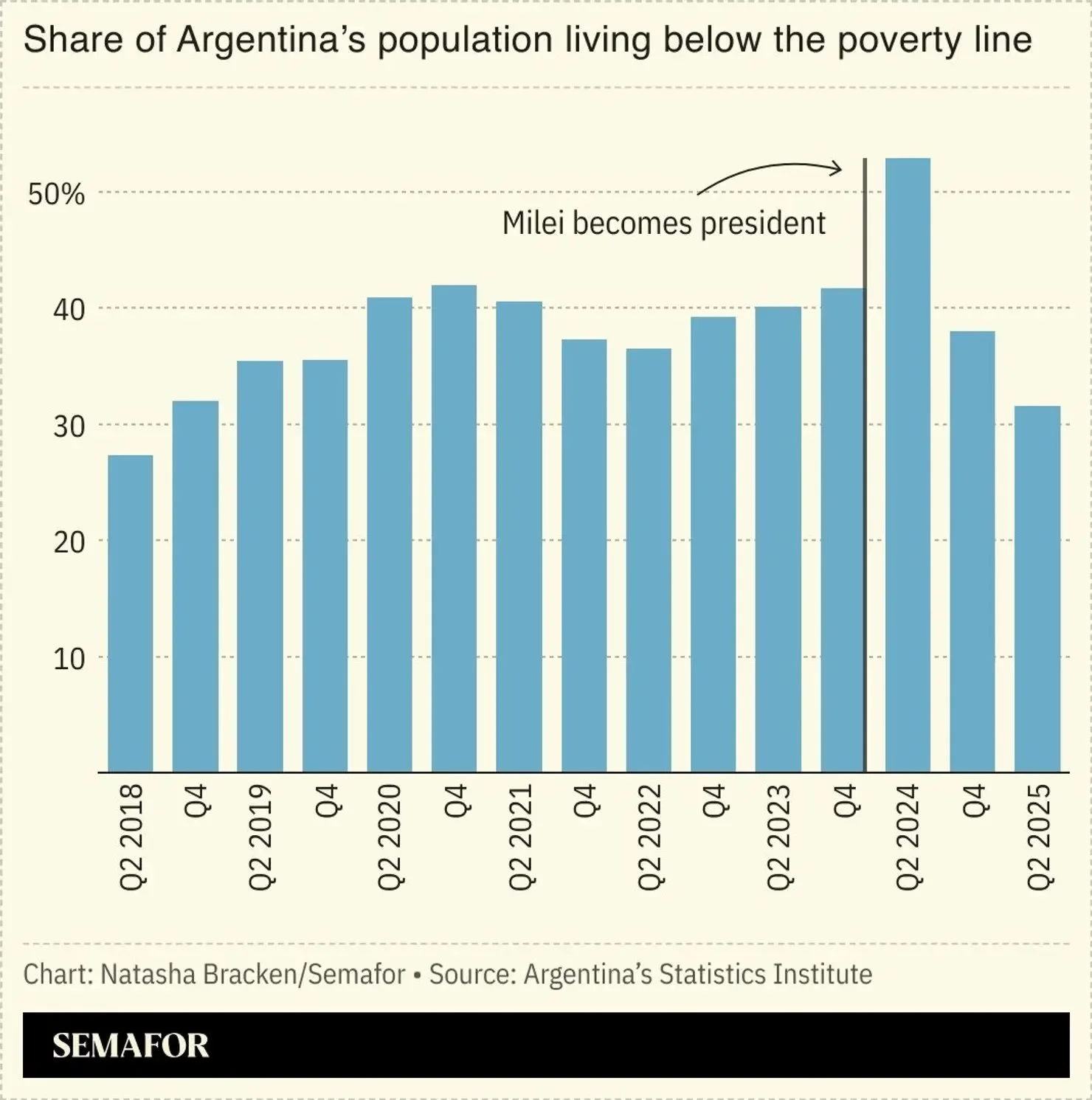
Poverty continued to fall, reaching 28.2% by 2026, a six-year low.
Perhaps most striking, Argentina addressed the debt crunch that analysts had warned about. When a $4.3 billion debt payment came due on July 9, 2026, Argentina met it without draining net reserves, surviving precisely the scenario that had previously triggered a catastrophic default.
Part III: The Human Cost
Pain and Protests, but Progress
The numbers are moving the right direction, but the austerity measures were extremely hard on the population in the short-term. According to a 2024 survey, 91% of Argentine households carried some form of debt, and 58% of those loans were taken out simply to buy food. Natural gas bills increased by nearly 1,500%. Retirees on fixed pensions were hit hardest and there were mass protests.
Despite the hardships, Argentines delivered a clear verdict in the October 2025 congressional elections.
Milei's party, La Libertad Avanza, won 41% of the vote, well ahead of the Peronist opposition at 31%. It was the first time since 1989 that the Peronists failed to hold the largest bloc in parliament, a historic realignment.
Many Argentines, while suffering under austerity, blamed the previous government for the crisis and were willing to give Milei's experiment more time. They had seen inflation conquered, the budget balanced, and the currency stabilized, which are achievements that had eluded every Argentine government before.
Part IV: What the World Can Learn
Argentina's experience offers lessons for countries facing similar, less extreme fiscal challenges. The parallels to the United States and other developed economies are worth examining.
Lesson 1: Deficits and Debt Eventually Matter
Argentina's core problem was spending far more than it collected in taxes, year after year, and printing money to cover the difference. This seems obviously unsustainable, yet many countries are on similar trajectories.
The United States ran a deficit of approximately $1.8 trillion in 2024, which is 6.4% of GDP. Total national debt exceeds $36 trillion, over 120% of GDP. Just the interest payments on the debt now exceed $1 trillion annually, which is more than the defense budget.
The US has advantages Argentina lacked: the dollar is the world's reserve currency, creating almost unlimited demand for US debt. But this is an advantage, not magic. Argentina's experience shows what happens when creditors lose confidence.
Lesson 2: Independent Central Banks Are Essential
Argentina's central bank was repeatedly forced to print money to cover government deficits, destroying the currency's credibility. Milei's success in killing inflation came largely from making the central bank genuinely independent.
The US Federal Reserve has maintained meaningful independence. When inflation spiked in 2021–2023, the Fed raised rates aggressively despite political pressure. This credibility is precious and worth protecting.
Lesson 3: Price Controls and Subsidies Create Distortions
Argentina's rent controls were intended to help tenants but instead caused landlords to withdraw properties from the market, reducing supply and ultimately hurting renters. When Milei repealed them, supply increased 170%, and real prices fell 40%.
Similar dynamics play out in the US. Restrictive zoning laws and permitting requirements limit housing construction, driving up costs. Energy projects can take a decade to permit. Occupational licensing requirements have expanded from 5% of workers in the 1950s to 25% today—often protecting incumbents rather than consumers.
As Milei put it: “The solution that collectivists will propose is not greater freedom but greater regulation, which leads to stagnation.”
Lesson 4: Culture Matters
Milei is fighting a cultural battle as much as an economic one. In Peronist Argentina, wealth was treated as something to be redistributed rather than celebrated. Entrepreneurs were seen as exploiters rather than creators.
Milei is trying to shift this. “A successful entrepreneur is a hero,” he declared at Davos.
“'You are the entrepreneurs, you are the ones who create wealth.”
And: “Don't let anyone say ambition is immoral.”
Whether countries can sustain free-market reforms depends partly on whether their cultures embrace or resist entrepreneurship, hard work, and individual responsibility.
Conclusion: If You Want Happy People, Allow Free Markets
Javier Milei promised Argentines that the pain would be temporary, but the cure would be real.
“There will be light at the end of the road,” he had said.
Two and a half years in, the light is visible.
Inflation has been crushed from 211% to the low thirties.
The budget is in surplus.
The economy is growing again.
Poverty is lower than when he took office.
Reserves are at a seven-year high, and Argentina met a debt payment in 2026 that once would have triggered default.
There is a simple lesson buried in all of this, and it is worth stating plainly: if you want a prospering population rather than a struggling one… allow free markets.
Argentina spent a century doing the opposite.
Every attempt to command prosperity into existence through spending, subsidies, price controls, and the printing press produced the same result: inflation, capital flight, and decline.
The country that was once richer than France taxed, regulated, and inflated itself into chronic crisis.
Milei's wager was that the fastest way back up was to simply stop doing the things that had caused the fall. To get the state out of the way and let markets, savings, and work do what they reliably do.
There have been human costs during the turbulent transition: a devastating if temporary poverty spike, rising unemployment, mass protests, and tension around managing civil liberties and press freedom.
The currency remains somewhat fragile, and Argentina's single most consistent historical habit is abandoning reform the moment it starts to work.
The momentum could still be reversed.
But for now, a country that the world had written off is stabilizing, growing, and drawing investment by doing something no other democracy has had the political nerve to attempt.
Whatever your politics, that makes Argentina one of the most important economic case studies of our time: a live test of whether radical free-market reform can deliver where a century of intervention failed.
So far, the answer looks like yes.
As Milei never tires of reminding his supporters: '¡Viva la libertad, carajo!'
Long live freedom, damnit.
From around the world we are watching and taking notes.
I salute the people of Argentina for their courage and wisdom to select a leader like Milei and their fortitude to persevere through difficult times in order to earn their just desserts.
Sources
Buenos Aires Herald, Buenos Aires Times, Al Jazeera, Human Rights Watch, CATO Institute, Friedrich Naumann Foundation, Trading Economics, Reuters, France 24, PIIE, MoneyWeek, GIS Reports, Michigan Journal of Economics, Focus Economics, NPR, Bloomberg, MercoPress, Reporters Without Borders

This is a unique quarter for Rolling Fun. We've capitalized on a fortunate twist early in this quarter. If you've ever considered investing in Rolling Fun, this is the quarter to join! Reply to chat with me about it or apply here.
We invest in obsessive geniuses building utopian technologies.
We write small checks to 10-15 very different startups each year. Previous investments include Aalo Atomics, Ouros Energy, Stell Engineering, Airship, Terraform Industries, Longshot, Dirac, Occam, Atomic Industries. and more.
Our Website has background on the fund, our past deals, and more.
*Startup investing is risky, illiquid, and not for the faint-of-heart. Be warned.
Accredited Investors: reply to this email, and we'll get you into our new investments starting this quarter.