What If Height Were a Power Law?
We’re trying to understand how the world really works.
Much of the world is normal.
But some areas always seem surprising.
Which is weird… because the surprise should fade, but it doesn’t.
This is a flag for a counterintuitive truth – something we have to hammer into our minds and revisit often to prevent a blind spot from re-forming.
The Power Law is a counterintuitive source of blind spots.
A “Power Law” is when a small group drives the majority of the results.
Like that classic joke, "When Warren Buffett walks into a bar, everyone in the room becomes a millionaire on average."
I often struggle to explain Power Laws without drawing on a napkin, waving my arms around like a lunatic, and using math words that make people regret going out to dinner with me.
("Power" here means exponential, like “2 to the power of 2” – so you can also think of these as exponential laws or exponential games, if that’s clearer than ‘power’)
This post captures what I use as an example to illustrate how different “normal games” are from “power law games”
Often, 20% of the work does 80% of the output.
That’s the Pareto Principle, which people talk about often.
And obviously, you want to know which 20%, so you can focus your effort there to get the best results for your effort.
But the 80/20 is fractal. It stacks on itself.
When it stacks, things get very surprising.
Take the 80/20 OF the top 20%. 96/4. Take the 80/20 of the top 4%, 99/1. Etc, etc, etc.
In Power Law games, a very small number of actors/actions drive the majority of the results.
If you ignore or deny this counterintuitive truth, you’re doubling your effort for half the results across your entire life.
So, let’s hammer power laws into our heads…
Why Height is a “Normal” Game
Look around. Most adults are between five and six feet tall. A few are shorter. A few are taller. Nobody is 40 feet tall.
Human height follows a “normal” distribution. The bell curve. Most people cluster around the middle, and the extremes aren't very extreme.
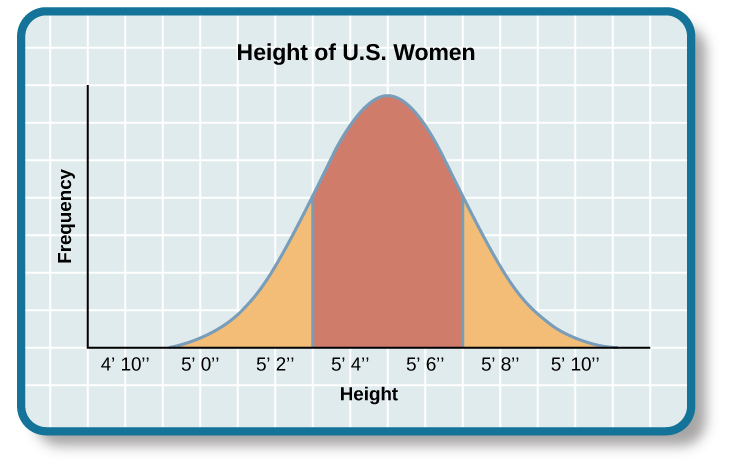
The average adult man worldwide is about 5'7". The tallest man ever measured, Robert Wadlow, was 8'11". That's just 1.6x the average.
Across all eight billion humans, the tallest one still fits in your house.
But many things in life aren't distributed normally; they are distributed exponentially.
Personal Relationships.
Investment returns.
Book sales.
Here, the top people produce results thousands or millions of times bigger than the middle.
Power laws are hard to feel. Let's make one visible.
The thought experiment: Height as a power law
Imagine 8.2 billion people with an average height of 5'7".
Now change the shape of the distribution. Make it exponential.
The tallest 20% of people account for 80% of all height, and it’s fractal.
Here's who you'd meet:
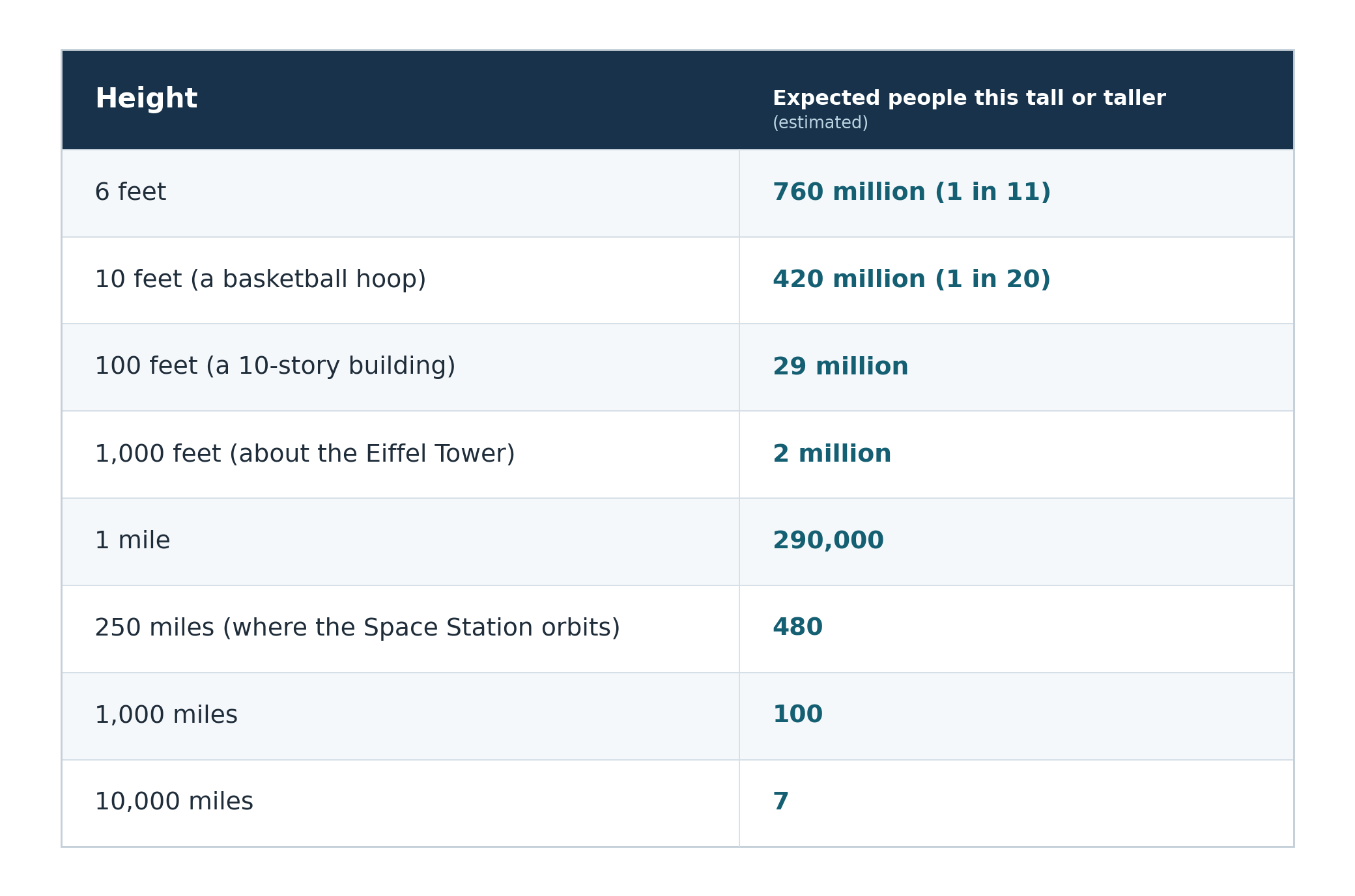

Even at 51,000 miles tall, you'd still expect one person on Earth to be even taller.
They might be 8 Earths tall.
(And they could be even taller!)

The person right in the middle of the distribution is only 17 inches tall. Knee-high.
25% of people are under 12 inches.
Three Epiphanies About Power Laws:
1. Almost everyone is below average. The average is 5'7", and 90% of people are shorter (most of them much shorter!). A few giants drag the average up. In this world, "average" describes almost nobody.
2. The top 1% account for more than half the total. Add up everyone's height. The tallest 1% account for 53% of the inches. The extremes dominate the total. In our real world, the tallest 1% account for only a sliver more than 1%.
3. Your experience lies to you. In a bell-curve world, meeting a thousand people or a million barely changes your estimate of the tallest person. In this power-law world, if you met a thousand people, the tallest you'd meet is around 300 feet.
Imagine how extraordinary a 300-foot person would seem. Imagine how confidently you'd call them a giant. You'd be right, of course. But you'd also have barely scratched the surface of what's possible.
If you met a million people, you might meet someone 20 miles tall.
Every time you think you've seen the biggest, you're probably wrong, and there's someone much, much taller.
We make this mistake all the time. We look at the most successful business we've encountered, or the most talented person we know, and unconsciously treat them as approximations of the limit.
Don't mistake the tallest person you've seen for the tallest person possible.
The ceiling on Power Law games is higher than you can fathom, because the winner is off the map, beyond any expectations or precedent. Passionate, irrational, driven missionaries push the frontier.
Obvious examples include Elon Musk, the world’s first Trillionaire (I just published a book about him), and MrBeast, who has 10% of the human population watching his videos. (and who I have a book coming out on next year!)
To further expand on #1, in power-law worlds, the “average” basically doesn’t exist in any individual.
You can’t design something for the average person in a power law set and expect it to work.
Imagine being Spotify.
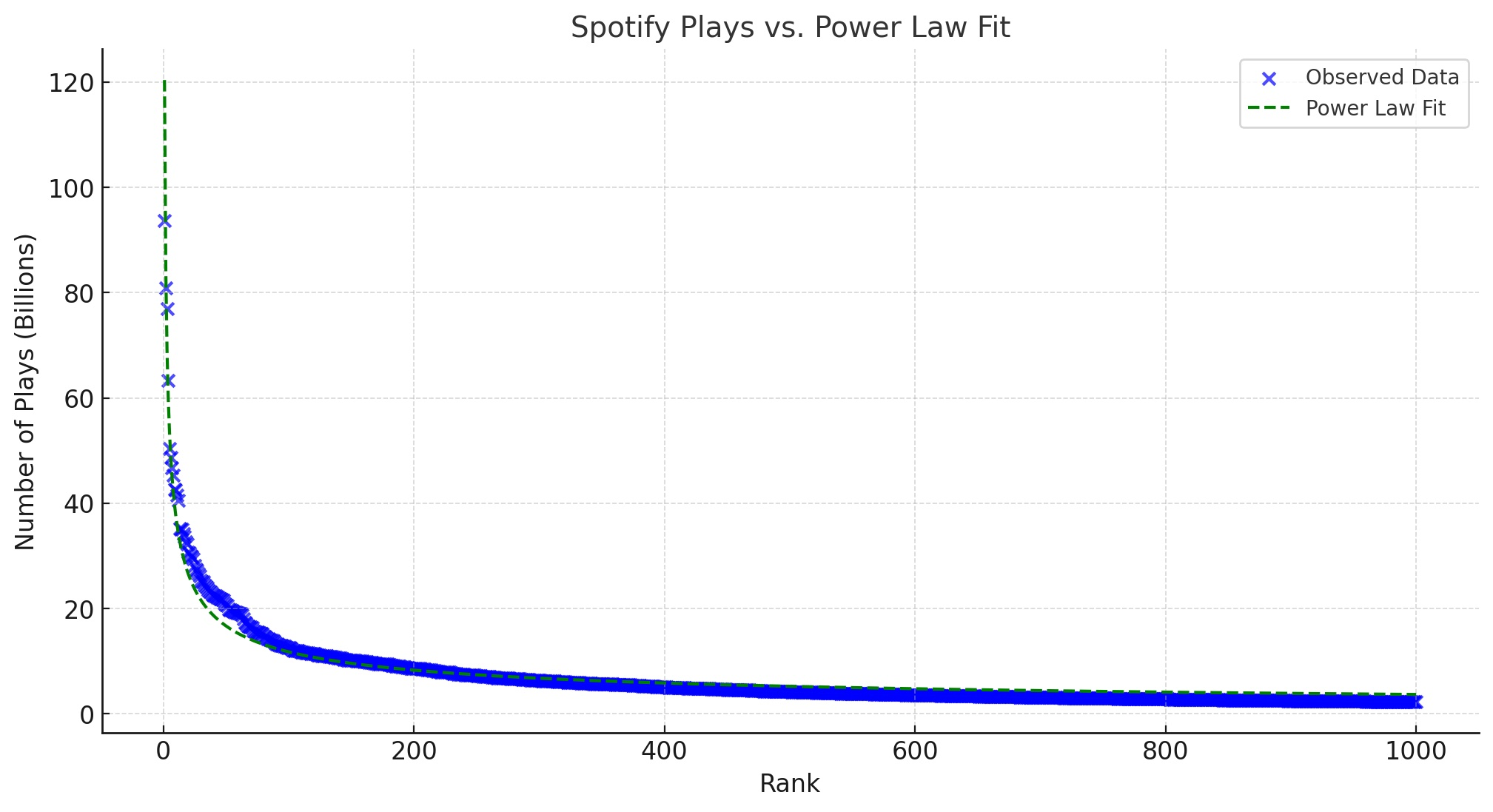
By the end of 2025, 253 million tracks had been published on streaming services. About 120 million of them (HALF!) got fewer than 10 plays that year, essentially zero. 88% got fewer than 1,000.
You have to make a product that works for Taylor Swift (who has 130 billion streams!) and a hundred million artists who get 10 plays each.
Why this matters
Look at the world with a bell-curve brain, and you'll make two mistakes.
You'll assume the middle tells you what is normal.
You'll dismiss the outliers as flukes you can ignore.
In a power-law world, the giants are the most important part. They’re what you should focus on, almost exclusively.
Finally, one clear takeaway I repeat to every founder, investor, creator, or artist that I talk to about this:
Realize that the returns for climbing higher in a power-law game are much larger than your intuition tells you.
If you can go from the top 10% of your field to the top 1%, you might earn 10x more, not 2x more. If you can move to the top 0.1%, you might earn 100x more.
Other pieces related to Power Laws:
How Claude ran the numbers: It used a Pareto distribution with an exponent of 1.161 (the exact 80/20 shape), and a theoretical average of 5'7". Real-world distributions are rarely exact power laws across their entire range; it’s a rough illustration.

Want to invest in startups with us?
We fund geniuses building utopian technologies.
We write small checks to 10-15 very different startups each year. Previous investments include Aalo Atomics, Ouros Energy, Stell Engineering, Airship, Terraform Industries, Longshot, Dirac, Atlas, Atomic Industries and 40+ more.
Our Website has background on the fund, our past deals, and more.
Startup investing is risky, illiquid, and not for the faint-of-heart. Be warned.
Accredited Investors: reply to this blog post, and we'll get you into our new investments starting this quarter.